


You know that moment. It’s midnight, the lights are off, and you’re shuffling to the kitchen for water. You stub your toe on the rug, mutter something unprintable, and your cat glides right past you. Calm. Unbothered. Maybe even a little smug.
So yes, it really does look like cats have night vision goggles built in. Most owners I know have asked the same thing at some point: can they see in total darkness?
Nope. Not in total darkness. Nothing can see without any light at all. But cats get by on so little light that a room that looks black to you is basically a dimly lit hallway to them. Here’s how that works, and what you can do to make nights easier for your cat.
Table of Contents
Big pupils, lots of rods
Start with the pupils. In low light, a cat’s pupils open wide, much wider than ours, to grab every bit of light available. Then there’s what’s inside the eye. Cats have far more rod cells than we do, and rods are the ones that handle dim light and movement. The result is that a cat needs roughly one-sixth of the light we do to see well.
That also explains why they’re so good at spotting a tiny bug moving across the wall at 2 a.m. while you see absolutely nothing.
So why do their eyes glow?
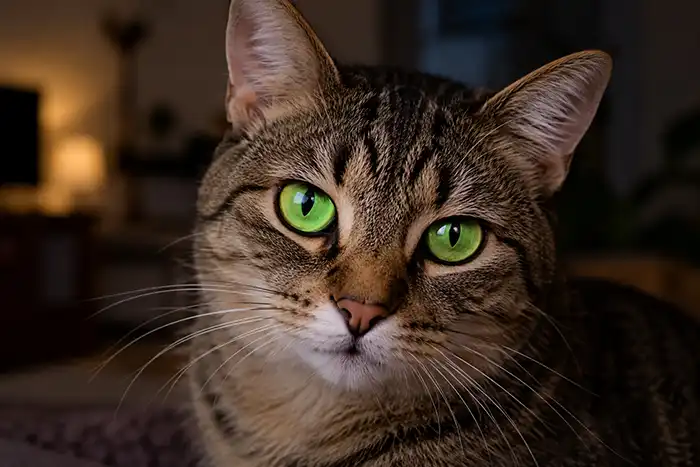
Ever shine your phone flashlight at your cat and get those spooky green or yellow eyes staring back? That’s the tapetum lucidum, a reflective layer behind the retina. It works like a tiny mirror. Light that passes through the retina without being caught gets bounced back for a second chance. Better odds of catching light means better vision in the dark. The glow you see is just that reflection coming back at you.
What cats are not great at
Here’s the part people don’t expect. Cats aren’t amazing at everything visual. Their color vision is limited, so the world looks more muted to them than to us, mostly blues and greens with reds fading out. Things very close to their face also look blurry.
That’s where whiskers come in. Those long whiskers pick up tiny air movements and help your cat judge distance and spot objects right in front of its nose, which is handy in the dark.
Helping your cat at night
Your cat is already well equipped, but a few small things help, especially for kittens and older cats:
- Keep the usual paths clear. A cat who knows the layout by memory will still appreciate not finding a new box in the way.
- Put a soft night light near the litter box, food and water. Senior cats really benefit from this.
- Try not to rearrange furniture often. Cats map their space, and surprises can throw them off.
- Play with them in the evening. A tired cat is far less likely to sprint through the house at 3 a.m.
- Watch for changes. If your cat suddenly misjudges jumps, bumps into things, or you notice cloudy or oddly sized pupils, see a vet. Many eye problems can be managed if you catch them early.
The bottom line
Your cat isn’t a secret superhero. It’s just built for the night shift, with big pupils, plenty of rods and a built-in mirror in each eye. A little help from you makes those late-night adventures safer, and maybe next time you’ll even stay upright on the rug.
1. The Direct Answer: Can Cats See in the Dark?
Cats cannot see in complete darkness. If you put a feline in a sealed room with zero light sources, they will be just as blind as a human. However, in low light or dim settings, cats outperform human sight by a massive margin.
Cats are crepuscular creatures. This means they are naturally most active during dawn and dusk. Their eyes evolved to hunt small prey during twilight hours when light levels are faint. According to feline eye research at the VCA Animal Hospitals, cats need only about one sixth of the light that humans require to navigate and detect movement clearly.
2. Anatomy of Feline Vision: Rods vs Cones
To understand feline night vision, we need to examine how retina cells process light. Retina tissues contain two main types of photoreceptor cells: rods and cones.
- Rods for Motion and Light: Rods detect movement and function in faint light. Feline retinas contain roughly six to eight times more rod cells than human eyes.
- Cones for Color and Detail: Cones process bright light and color perception. Humans have far more cone cells, which allows us to see vivid colors and crisp details during daylight.
Because cats possess an overwhelming abundance of rod cells, their eyes gather available ambient light with exceptional efficiency. They sacrifice bright daytime color richness to gain high performance during dim nighttime hours.
3. The Secret Weapon: Tapetum Lucidum
If you have ever taken a flash photo of your pet or spotted them in your hallway at night, you probably noticed their eyes shining like tiny lanterns. This striking effect comes from a special layer of tissue called the tapetum lucidum.
Located directly behind the retina, the tapetum lucidum acts like a retroreflective mirror. When light enters the eye, it passes through the photoreceptors and hits this layer. The tapetum lucidum bounces the light straight back through the retina a second time. This gives the photoreceptor cells a second opportunity to absorb the light energy.
This double exposure mechanism turns faint moonlight or hallway nightlights into bright visual signals for your cat’s brain.
4. Pupil Dilation and Curvature
Feline eyes feature vertical slit pupils that offer distinct mechanical advantages over human round pupils. During bright midday sunlight, a cat can contract its pupils into thin vertical slits to protect sensitive retinal tissue.
When ambient light drops, those same slits expand dramatically into wide circles. A fully dilated feline pupil can expand up to 135 times its minimum area. In contrast, human pupils expand roughly 15 times. This extreme expansion floods the inner eye with every available photon of light in the environment.
5. Human Vision vs Cat Vision Comparison
To visualize how your vision compares to your pet, review this side-by-side comparison:
| Visual Feature | Human Vision | Feline Vision |
| Dim Light Sensitivity | Low (Requires bright light) | High (Needs 1/6th human light) |
| Pupil Expansion | Up to 15x expansion | Up to 135x expansion |
| Field of View | 180 degrees total | 200 degrees total |
| Retinal Rod Count | Moderate | 6 to 8 times higher than humans |
| Color Spectrum | Full RGB spectrum | Blue-green spectrum (Limited reds) |
| Best Distance Sight | 100 to 200 feet | 20 feet (Near-sighted) |
A little story from my own house
Last winter, around 3 a.m., I woke up to the sound of tiny paws thundering down the hallway. No lights were on. I peeked out, half asleep, and saw my cat Mishti racing after her toy mouse, taking the corner by the shoe rack like she’d done it a thousand times. She didn’t bump into a single thing.
The next night I tried the same hallway myself and walked straight into the door frame.
That’s when I noticed the faint green glow of the microwave clock in the kitchen. To me it was barely there. To Mishti, it was probably all the light she needed. It made me realise how little light a cat actually requires, and how much of the “night vision” magic is really just clever eyes working with tiny amounts of light.
6. How Cats Use Other Senses in Darkness
Sight is only one piece of the puzzle. When navigating dark spaces, cats rely heavily on an interconnected network of physical senses:
- Tactile Whiskers (Vibrissae): Feline whiskers are deeply rooted in sensitive nerve endings. They detect subtle air currents and measure doorway widths without the cat needing to see the edges.
- Acute Hearing: Cat ears can rotate 180 degrees independently. They detect high-frequency squeaks and rustles that humans completely miss.
- Scent Trails: Cats mark household furniture with facial pheromones, creating invisible scent maps that guide them through familiar rooms.
Expert studies published by the American Veterinary Medical Association confirm that feline spatial memory combined with tactile sensory input allows cats to move comfortably even when light levels drop near zero.
Related Guide: Can Dogs Eat Bananas? 5 Amazing Benefits & Risks
7. Aging Cat Vision and Night Care
As cats grow older, their vision can deteriorate due to conditions like nuclear sclerosis, cataracts, or hypertension. Senior pets may begin hesitating at staircases or vocalizing at night if they lose confidence in low light.
Printable Night Safety Checklist for Cat Owners
To ensure your home remains safe for your feline companion at night, follow this quick checklist:
- [ ] Install Soft Nightlights: Place low-wattage LED plug-ins near litter boxes, food bowls, and staircases.
- [ ] Keep Floor Pathways Clear: Avoid leaving shoes, boxes, or toys in high-traffic corridors.
- [ ] Maintain Furniture Layouts: Avoid rearranging major furniture items frequently if you have a senior pet.
- [ ] Provide Elevated Perches: Ensure window sills and cat trees are stable and easily accessible.
- [ ] Schedule Eye Checkups: Have your veterinarian inspect your cat’s eyes annually for cloudiness or pupil responsiveness.
Related Guide: Can Dogs Eat Watermelon? 5 Amazing Safe Benefits & Serving Guide
Frequently Asked Questions
Can cats see in total darkness?
No, cats cannot see in 100% pitch black darkness. They require a small amount of ambient light, such as moonlight or distant streetlights, to activate their tapetum lucidum and retinal rod cells.
Why do cat eyes glow in the dark?
Cat eyes appear to glow because of the tapetum lucidum layer behind their retinas. This layer acts like a mirror, bouncing unabsorbed light back out through the eye.
Should I leave a light on for my cat at night?
In most indoor homes, faint light from electronics or windows provides enough vision for cats. However, leaving a small nightlight near their litter box is helpful for senior cats or kittens.
Conclusion
Can cats see in the dark? While they cannot see in complete pitch blackness, their remarkable biological evolution makes them masters of low-light vision. Through large pupil expansion, abundant retinal rods, and the light-reflecting tapetum lucidum, your cat navigates twilight hours with ease.
By keeping clear pathways and placing soft nightlights in key areas, you can support your pet’s natural instincts and keep them safe every night.
Related Guide: Can Dogs Eat Apples? 5 Amazing Safe Benefits & Serving Guide